
Have you ever had a conversation with an employee, reached agreement on what needed to change, and then watched the same issue happen again a week later?
Many leaders assume that once a conversation happens, accountability is in place. But agreement does not equal accountability. Accountability is not created in the conversation. It is created in the follow-through.
Why Accountability Doesn’t Stick
Most teams are good at talking about problems. They discuss missed deadlines, unclear expectations, and recurring issues. Everyone agrees on what needs to happen. Then nothing changes.
Why?
Because accountability requires more than a conversation. It requires:
- clear expectations
- ownership
- follow-up
- consistency
Without these elements, the same issues keep resurfacing.
6 Steps to Making Accountability Stick
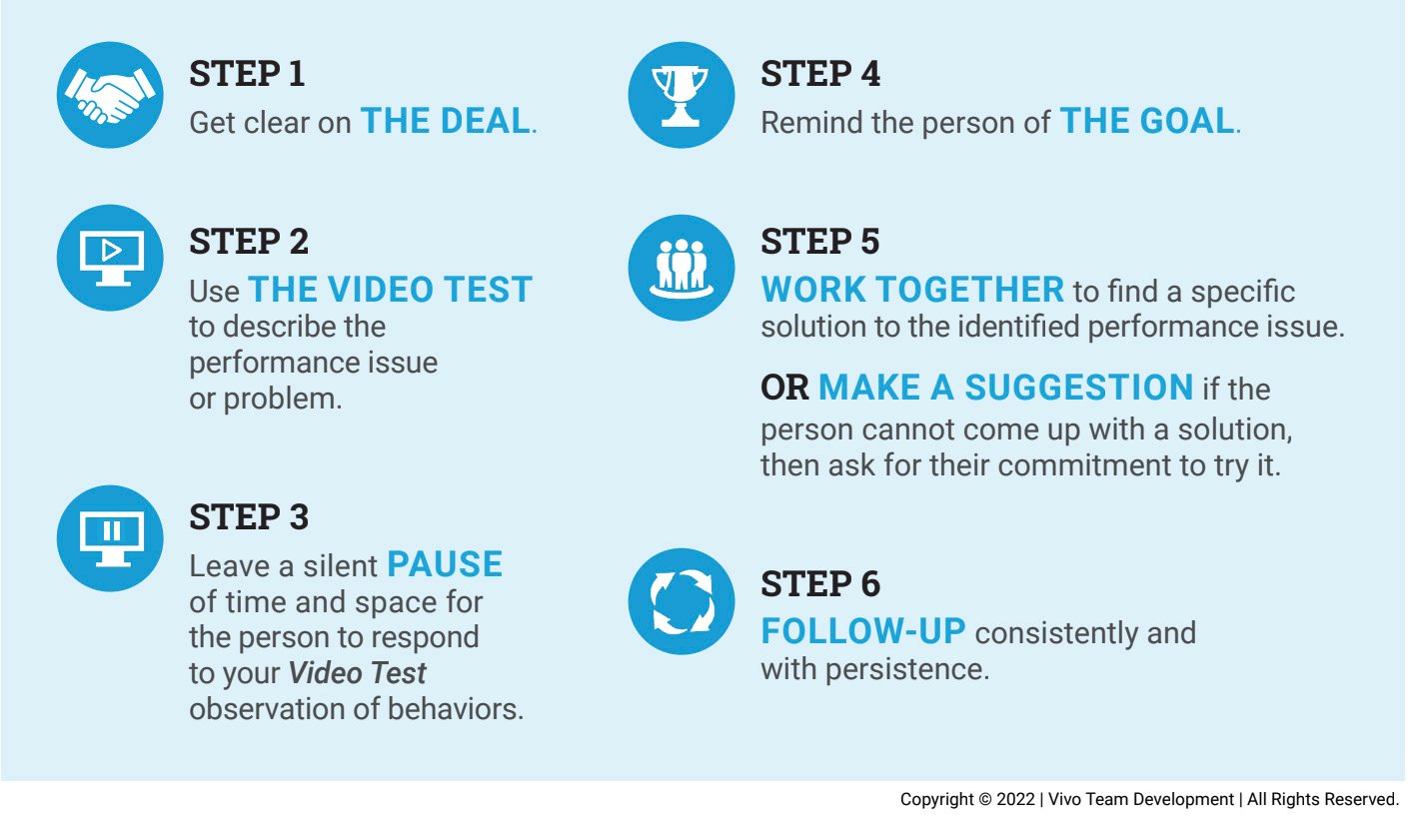
1. Get Clear on "The Deal"
Getting clear on “The Deal” means creating a partnership in which everyone understands the expectations of the role or task.
In accountability conversations refer back to "The Deal" avoiding vague statements like:
- “Do better.”
- “Be more proactive.”
- “Take more ownership.”
Instead, define exactly what success looks like.
-
What needs to happen?
-
By when?
-
What does good performance look like?
2. Use the Video Test
The video test is a tool to distinguish between what people are saying or think they are doing and what they are actually saying or doing.
Here’s how it works:
-
Imagine you are watching a video of what the person is or was doing or how they are behaving.
-
What do you see? What do the behaviors tell you?
- What would you say to the person based on your observations?
For example: “I noticed you missed the last two deadlines.”
This keeps the conversation objective and reduces defensiveness.
3. Pause
After stating the issue, stop talking.
This is one of the most critical and important things managers must learn to do: wait in silence for a response.
This is where ownership begins.
4. Reconnect to the Goal
Now is the time to get back to doing what needs to be done to help the person learn how to become accountable for their performance.
-
Explain why the behavior matters.
-
Tie it to the team’s priorities, deadlines, or customer outcomes.
-
This keeps the conversation focused on results rather than personalities.
5. Build the Solution Together
Ask: “What’s your plan to fix this?”
If the person struggles, work through the solution together.
But they need to own the plan.
6. Follow Up
This is where accountability either sticks or falls apart.
No follow-up means no change.
Consistency turns conversations into results.
Agreement ≠ Action
One of the most common leadership mistakes is assuming that agreement automatically leads to action.
It doesn’t. People change when:
- expectations are clear
- ownership is established
- progress is reviewed
- leaders follow through consistently
The Cost of Weak Accountability
When accountability is weak:
- deadlines are missed
- mistakes are repeated
- frustration increases
- top performers carry the load
- productivity declines
And leaders spend valuable time addressing the same issues again and again.
Accountability Is a Leadership System
Accountability is not about being tougher on people. It is about creating the clarity, structure, and consistency people need to succeed.
When accountability is strong:
- commitments are honored
- ownership increases
- performance improves
- leaders spend less time repeating themselves
The Bottom Line
If nothing changes after your conversations, ask yourself:
Did we simply agree?
Or did we create accountability?
Because agreement starts the conversation. Accountability creates the results.
Download: The 6 Key Indicators of Highly Functioning Teams
If you want to identify where your team is losing productivity and how to fix it, download the full guide:
Full Video Transcript
Are you having the same conversations over and over again and nothing seems to change?
You don't have a communication problem, you have an accountability problem.
I'm Renee Seffrada, and here's what most leaders miss.
Agreement does not equal accountability.
Most teams talk through things.
They leave the meeting feeling clear, and then nothing actually changes, because accountability doesn't actually happen in the conversation.
It happens in the follow-through.
So let's talk about Sam.
She leads a marketing team, and one of her team members keeps missing deadlines.
She addresses it, and of course the person says it won't happen again, and for a week she does see improvement, then another deadline slips.
After a few weeks later again, this keeps happening and happening, and Sam just keeps getting more and more frustrated.
Nothing is sticking.
Fixing this isn't about being harder on people.
It's about being clear and consistent.
And here's what really works.
It's a series of steps.
Step one, you need to get clear on what the deal is, what exactly needs to happen.
That doesn't mean saying, do better or be more proactive.
You need to really be specific about what does success look like.
And then step 2 is what we call the video test.
It's describing what you actually see, not assumptions, not interpretations, but observable behavior.
For example, I noticed you missed the last 2 deadlines, and step 3, most important, pause.
Most leaders rush to fill the silence, and that's where they get into problems.
Don't do that.
Let the other person respond.
That's where ownership begins.
And step 4, reconnect again to that goal.
Why does this matter?
Tie the behavior to the team's outcome.
Don't make it personal.
This is actually a shared responsibility.
Step 5 is build the solution together.
Don't just tell them what to do.
Ask, what's your plan to fix this?
And if they can't answer, then work it through with them.
But they do need to own it.
Step 6, follow up.
This is where accountability breaks.
No follow up, no change.
Consistency is what turns conversations into big results.
When accountability is weak, the cost shows up everywhere, missed deadlines, repeated mistakes, frustrations, and your top performers quietly carry the load.
That's not just frustrating, that's expensive.
Because when nothing changes, you keep paying for the same problem over and over and over again.
When you build accountability into your team, your team operates, things start to stick, and performance improves, and leaders get out of that cycle of repeating it over and over again.
If you want to explore more ways to drive team performance, download Vivo Team's guide, the six key indicators of highly functioning team in the link below.
Let's stop repeating the problem and start reinforcing the solution.
Because when you invest in people, the results will follow.
When people truly understand the message, work gets done the right way the first time.